





 SecurityTokenizer

Subscribe Our Newsletter
Polygon vs Solana - Which Is Faster, Cheaper, and More Secure?
Confused between Polygon and Solana? This Security Tokenizer guide breaks it down in a simple way, speed, cost, and security, so you can see which blockchain fits real-world projects like tokenization, gaming, and finance.
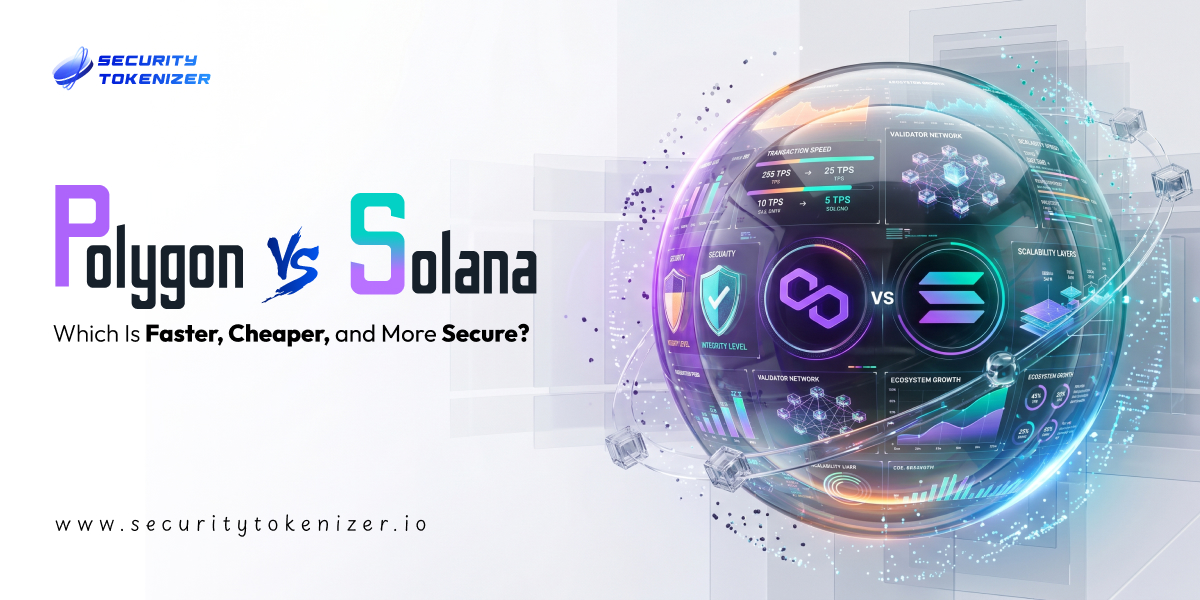
Table of Content
Blockchain is now part of everyday digital systems, powering payments, digital assets, gaming economies, and early stages of real estate tokenization. Among today’s blockchain networks, Polygon and Solana are the two blockchain networks often compared today as they both aim at solving the same problems but in different ways.
Both aim to solve a common issue: traditional blockchains can become slow and costly when user activity increases. However, each takes a different approach to handling these drawbacks. This comparison between Polygon and Solana is not about which one is universally better. Instead, it is about understanding where each one fits best in today’s growing digital economy.
Overview of Polygon and Solana Architecture
Polygon acts as a Layer 2 scaling solution that complements Ethereum. Instead of carrying out all the transaction processing on the main Ethereum network, it operates its own layer, and later the recorded final results are sent back to Ethereum. This way, the platform reduces congestion on the main chain while remaining connected to a highly trusted blockchain system.
Solana is a Layer 1 blockchain that is not dependent on any other network for settlement. The blockchain implements a hybrid consensus mechanism of Proof of History (PoH) and Proof of Stake (PoS) to execute transactions and reach consensus in the network. This design allows the network to handle large volumes of transactions at low cost, making it suitable for applications where real-time activity matters.
Security Model Comparison
Security plays a major role when selecting a blockchain for financial systems or tokenized assets.
Polygon’s Ethereum-Inherited Security
Polygon benefits from its connection with Ethereum, which adds a strong layer of trust. Polygon inherits Ethereum's 900,000+ ETH staked across validators, providing enterprise-grade trust. In many cases, Polygon transactions can be anchored to Ethereum for final validation.
Key strengths include:
- Access to Ethereum’s large validator ecosystem.
- Strong decentralization properties.
- Higher trust level for enterprise adoption.
Solana’s Independent Security Framework
Solana operates using its own validator network without relying on external chains. Solana runs on 2,000+ active validators with Proof of History + Proof of Stake, processing transactions with sub-second finality. Its security is entirely dependent on internal consensus and validator participation.
This model provides independence and high performance but also means:
- Network stability depends on validator health.
- Security is not backed by another chain.
- Performance and security are tightly linked.
Consensus Mechanisms Explained
Consensus determines how blockchain participants agree on transaction validity.
Polygon - Proof of Stake
Polygon uses Proof of Stake, where validators stake tokens to confirm transactions. This approach reduces energy consumption and keeps transaction fees low. It is widely adopted because it provides a balance between efficiency and decentralization.
Solana - Proof of History + Proof of Stake
Solana combines Proof of History with Proof of Stake, adding a time-based structure that helps organize transactions before validation. Together, they allow faster transaction ordering, reduced communication between validators, and high throughput under heavy usage. This combination is one of the reasons Solana is known for speed.
Performance and Scalability Differences
Performance is where both networks show clear differences.
Polygon Performance
Polygon improves scalability by handling transactions outside Ethereum mainnet and later settling final data on Ethereum. Polygon is commonly used where consistency matters more than extreme speed.
This results in:
- Lower congestion.
- Moderate to high throughput.
- Reliable performance for general applications.
Solana Performance
Solana is known for extremely high throughput, capable of handling thousands of transactions per second under ideal conditions. Its design prioritizes speed and responsiveness, especially under heavy network usage.
This makes it suitable for:
- Real-time trading systems.
- NFT Gaming platforms development.
- High-volume decentralized applications.
Tokenization Use Cases
Tokenization refers to converting real-world or digital assets into blockchain-based tokens. It is now used across industries to represent ownership, improve transparency, and simplify asset transfer in digital systems.
Both Polygon and Solana support tokenization, but they are applied in different real-world scenarios:
- Used in real estate tokenization platform, where property ownership is represented digitally.
- Applied in financial systems for asset digitization and investment products.
- Used in DeFi lending platform and borrowing models.
- Supports digital collectibles and NFT-based ownership systems.
- Plays a role in gaming economies where in-game assets hold real value.
In practice, Polygon is often chosen for structured and institution-driven tokenization use cases, while Solana token development is more common in fast-moving digital environments with high transaction activity.
Security vs Performance Trade-offs
In blockchain systems, security and performance often work in balance rather than in isolation. A network that prioritizes stronger security checks may process transactions in a more measured way, while a network designed for higher speed may handle large volumes of activity with a different internal structure.
Polygon is often preferred for structured and security-sensitive environments because of its,
- Strong alignment with Ethereum’s security framework.
- Uses a well-established validation structure.
- Suitable for trust-heavy and compliance-driven applications.
- Preferred for long-term financial and institutional use cases.
Solana, on the other hand, is built for applications where speed and constant interaction are more important. It benefits,
- Built for high transaction processing capacity.
- Uses an independent validator network.
- Designed for real-time and high-frequency applications
- Commonly used in gaming, NFTs, and trading systems.
Which One Fits Your Tokenization Needs?
Choosing between Polygon and Solana depends on the type of application being built and the environment it needs to support. Polygon is often selected for projects that require strong stability and compatibility. Solana is commonly chosen for applications that handle high transaction speed, which plays a major role in user experience.
As a leading Token development company, Security Tokenizer provides solutions that are built on both Polygon and Solana depending on the business model. This includes token creation, smart contract development, and building decentralized applications designed around specific performance and security needs. Working across both networks allows us to support different kinds of projects, from regulated tokenization systems to high-activity digital platforms. This approach helps businesses choose a blockchain setup that matches their actual use case instead of forcing a single direction.