





 SecurityTokenizer

Subscribe Our Newsletter
How Land Tokenization Works - Complete 2026 Guide for Real Estate Investors
Discover how land tokenization works in 2026. Learn the fractional ownership to digital trading, step-by-step process, benefits, and investment opportunities for real estate investors.
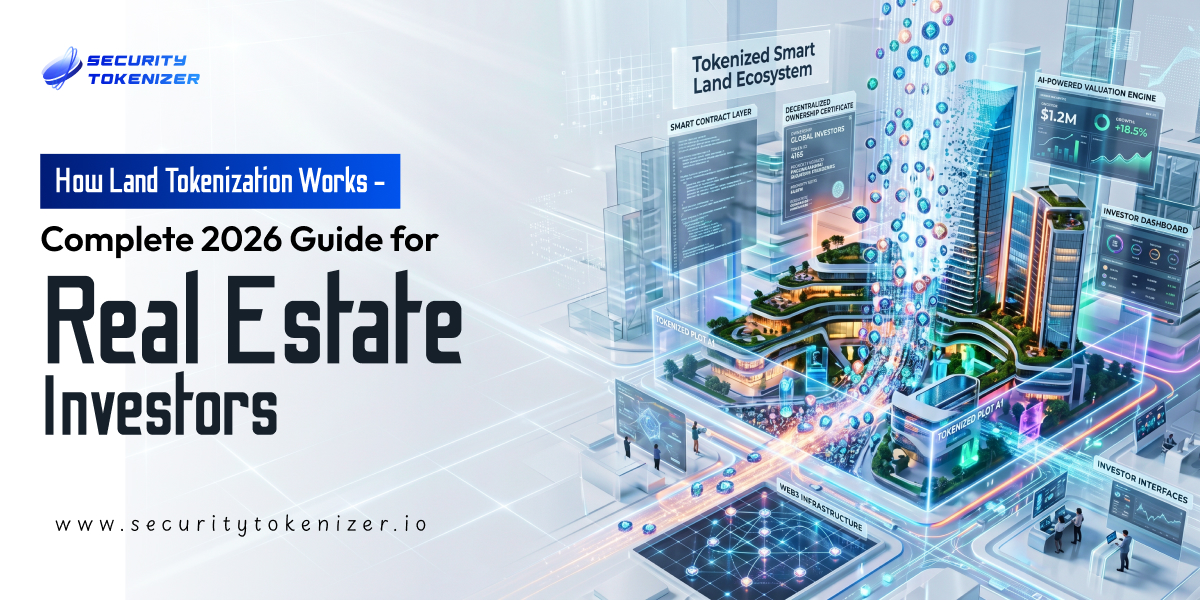
Table of Content
The real estate industry is experiencing a major digital transformation. By 2026, tokenization of land is considered one of the hottest topics in real estate investment and it is already estimated that the tokenized real estate market would be around $3 trillion by 2030. For real estate investors, this technology creates areas to invest, get liquidity, and generate income, which are still very difficult even with the traditional forms of real estate.
What is Land Tokenization?
Land tokenization is the process of converting ownership rights of a physical land asset into tokens that are recorded on a blockchain network. Instead of ownership being represented entirely through paper-based records, but the land is connected to digital tokens that represent fractions of the asset. Investors can purchase, keep, or sell these tokenized shares as the ownership arrangement set for the property.
Key Characteristics of Land Tokenization
- Digital representation of real-world land assets.
- Blockchain-based ownership, commonly using Ethereum, Polygon, and similar platforms.
- Fractional ownership that allows smaller investment amounts.
- Potential for 24/7 trading on secondary markets.
- Transparent ownership records stored on an immutable ledger.
How Land Tokenization Works
Step 1 - Asset Selection and Due Diligence
Tokenization starts when a landowner or developer decides on a property that is suitable for land tokenization like agricultural land, commercial plots, or unused land.
Step 2 - Legal Structuring (SPV Creation)
To facilitate token issuance, a Legal entity like Special Purpose Vehicle (SPV) or other legal entites is created that will be the legal owner of the property.
Step 3 - Property Valuation
By using the help of expert appraisers, a value of the property is established. The result from this valuation will be used to figure out the total number of tokens and their price.
Step 4 - Smart Contract Development
Developers create ERC-3643-compliant smart contracts that define ownership rights, dividend distribution mechanisms, and transfer rules.
Step 5 - Token Minting
Using the smart contract development tokens are created on the blockchain. A token is equal to a fractional share of the land ownership.
Step 6 - Primary Sale (IEO/ICO)
Tokens are sold to investors through an Initial Exchange Offering (IEO) ICO private placement, or any other approved way of raising funds in their wallets.
Step 7 - Secondary Market Trading
When these tokens become available on approved exchanges general investors can trade their tokens. Smart contracts automatically execute transactions and record changes.
Step 8 - Revenue Distribution
In case a property is generating revenues through rental income, lease, or farming production then smart contracts will pay the proceeds to the token holders in cryptocurrency or stablecoins.
Land Tokenization vs Traditional Real Estate Investment
Land tokenization introduces a different approach to property ownership compared to traditional real estate investing.
Lower Investment Requirements
Traditional real estate investments typically require tens or even hundreds of thousands of dollars. With tokenization, investors can participate in property ownership with investments starting from as little as $100 to $1,000.
Greater Liquidity
Selling a traditional property can take anywhere from 30 to 90 days or longer. Tokenized land assets can potentially be traded on secondary marketplaces, allowing investors to buy or sell their holdings more quickly.
Reduced Transaction Costs
Traditional property transactions involve brokers, legal professionals, and administrative fees that can account for 5–10% of the transaction value. Tokenized assets generally involve lower platform and processing fees.
Global Market Access
Conventional real estate investments are often limited by geography. Land tokenization allows investors to access opportunities across multiple countries from a single digital platform.
Built-In Fractional Ownership
Co-owning traditional property can be legally complex and time-consuming. Tokenization simplifies this process by dividing ownership into digital tokens that represent specific shares of the asset.
Transparent Ownership Records
Property records are traditionally maintained through paperwork and centralized databases. Blockchain technology records ownership and transactions on an immutable ledger that can be independently verified.
Faster Settlement Times
Traditional property transfers may take several weeks to complete. Tokenized transactions can be processed and recorded within minutes through blockchain networks.
Types of Land Assets That Can Be Tokenized
Land tokenization can be applied to a wide range of property categories, allowing investors to choose opportunities based on their investment goals and risk tolerance.
Agricultural and Farmland
Farmland is a popular choice for tokenization. Through tokenizing, investors become part-owners of the land and may benefit from income generated by the farming operations, leasing arrangements, or sale of crops.
Commercial Land
Commercial plots such as office parks, retail developments, and industrial zones are highly attractive for tokenization due to their potential rental income and long-term value appreciation.
Undeveloped Land
Vacant land designated for future residential or commercial development can be tokenized, giving investors exposure to potential growth as the surrounding area develops.
Residential Land
Housing plots and residential development sites can also be divided into tokens, allowing investors to participate in residential real estate markets without purchasing an entire property.
Development Projects
The land intended for future construction projects offers investors an opportunity to participate in property development before completion.
Rural and Remote Land
Although often more challenging to value and trade, rural land is gaining attention as investors seek long-term appreciation opportunities and alternative real estate assets.
Mixed-Use Properties
The land approved for both residential and commercial purposes offers flexibility and multiple revenue opportunities, making it an attractive option for tokenization.
Land Tokenization Use Cases in Real Estate
Land tokenization is creating new opportunities for investors and property owners by making real estate tokenization platform more accessible and flexible.
Fractional Farm Ownership
Investors can co-own farmland in regions such as Punjab, India, or Brazil's agricultural belt and earn a share of revenue from crop sales or land leases.
Luxury Property Access
High-value properties, including Dubai waterfront plots, can be divided into digital tokens, allowing investors to own a portion of premium real estate.
Real Estate Crowdfunding
Developers can raise funds for land and development projects through token sales instead of relying solely on traditional bank financing.
Cross-Border Investment
Investors can access international real estate tokenization opportunities, such as Indian land assets, without the challenges of direct foreign property ownership.
Estate Planning and Inheritance
Tokenized land can be divided among heirs more easily, simplifying property transfer and inheritance management.
Collateral for DeFi Loans
Land tokens can be used as collateral in decentralized finance platforms to access loans while retaining ownership.
Development Project Funding
Developers can attract a wider investor base and secure funding for future real estate tokenization platform projects.
Future of Land Tokenization in Real Estate
Land tokenization is expected to grow, with the tokenized real estate market projected to increase from $50 billion in 2026 to $3 trillion by 2030. Growing institutional adoption, clearer regulations, AI-powered property valuation, cross-chain compatibility, and the expansion of real-world asset (RWA) tokenization are driving this growth. As adoption increases, land tokenization is expected to become a more common real estate investment model, creating new opportunities for investors worldwide.
What Investors Should Know About Land Tokenization
Land tokenization is changing how investors access, own, and trade real estate. By combining blockchain technology with property ownership, it offers benefits like fractional ownership and more liquid markets. It also gives investors a chance to join global real estate sectors while keeping transactions clear and reliable.
As adoption tokenization grows across the real estate sector, understanding the fundamentals of tokenization can help investors enter this market. Security Tokenizer, a Token Development Company, helps businesses and property owners create compliant and scalable tokenization solutions that align with changing industry requirements and support the growing demand for digital real estate investments.