




 SecurityTokenizer

Subscribe Our Newsletter
Deflationary vs Inflationary Tokens - Which Model Creates More Value?
Explore how deflationary and inflationary tokens impact value, scarcity, and growth in 2026. Compare real examples and understand which token model performs better for investors.
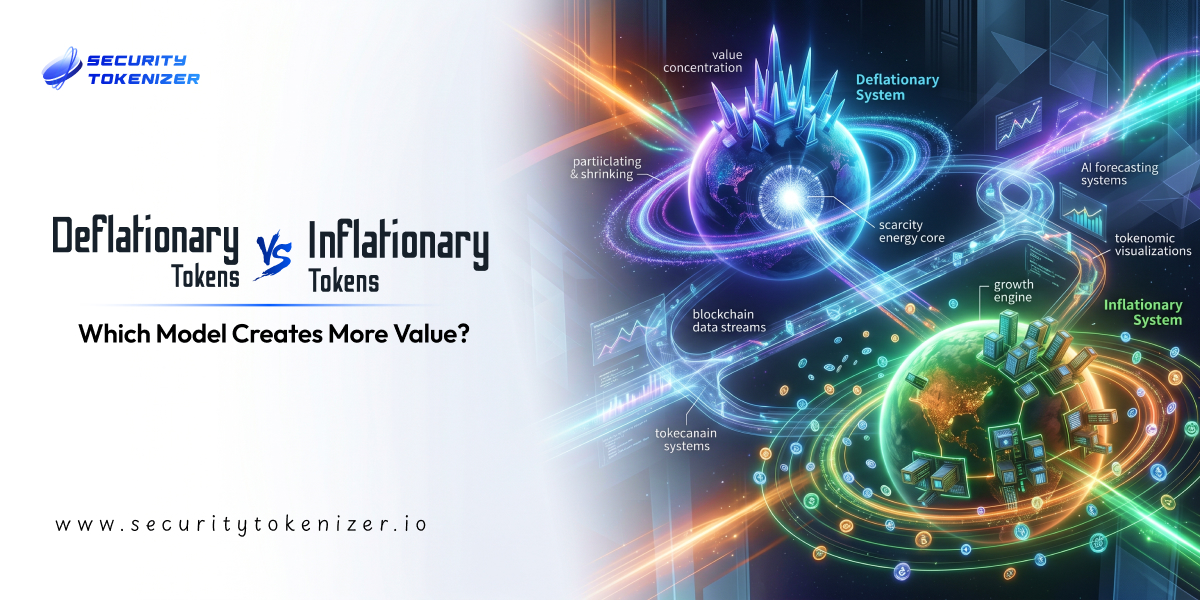
Table of Content
If two cryptocurrencies have the same demand but one continuously reduces its supply while the other keeps creating new tokens, which one is more likely to hold its value over time, The answer often comes down to tokenomics. Deflationary and inflationary token models influence how supply changes over time, affecting scarcity, utility, investor sentiment, and ultimately token value. Understanding these models is essential for investors, businesses launching tokens, and anyone evaluating the long-term sustainability of a crypto project.
What Are Deflationary and Inflationary Token Models?
Deflationary Tokens
The deflationary tokens aim to lower total supply gradually. The reduction of supply is collectively achieved through different methods like burning tokens, having a limited number of mints, or setting a maximum supply cap. Generally, as the supply goes down, scarcity increases. So, value may rise if demand stays at least steady or even grows.
Key characteristics:
- Fixed maximum supply
- Token burning mechanisms
- Buyback and burn programs from revenue
- Negative inflation rate
Inflationary Tokens
Inflationary tokens increase the supply over time. Based on the rules of the network, tokens are minted continuously, and the newly minted tokens are used as rewards or incentives for staking. This practice is beneficial in maintaining liquidity and also in encouraging the individuals to get involved in the network, In particular during the initial growth phase.
Key characteristics:
- Unlimited or expanding supply
- Continuous token issuance (mining/staking rewards)
- Positive inflation rate
- Designed for ecosystem growth and user incentives
How Deflationary Token Models Work
Deflationary systems reduce token supply gradually through built-in mechanisms. As supply decreases, remaining tokens may become more scarce. Many projects use this model to create long-term value perception and encourage holding behavior. Common methods include:
1. Token Burning During Transactions - A portion of every transaction fee is destroyed permanently.
2. Fixed Maximum Supply Limits - A hard cap prevents new tokens from ever being minted beyond a certain amount.
3. Buyback and Burn Programs - Projects use revenue to buy back tokens from the market and burn them, reducing circulating supply.
4. Transaction Fee Destruction - All or part of transaction fees are destroyed rather than paid to validators.
5. Halving Events - The periodic reductions in new token issuance.
How Inflationary Token Models Work
Inflationary models increase token supply over time. This model helps maintain liquidity and incentivizes users to participate in the ecosystem, especially in early growth stages. This is often used to support network activity and rewards. Key mechanisms include:
1. Mining Rewards - New tokens are minted and given to miners who validate transactions.
2. Staking Rewards - New tokens are issued to validators/stakers who secure the network.
3. Continuous Token Issuance - Fixed or variable inflation rate mints new tokens regularly.
4. Governance-Based Minting - Token holders vote on minting rates, allowing community control over inflation.
5. Liquidity Mining & Airdrops - Tokens are distributed to users who provide liquidity or complete tasks.
Deflationary vs Inflationary Token Models: Key Differences
Supply Behavior
The deflationary tokens reduce total supply over time through burning or capped issuance, which creates increasing scarcity. Inflationary tokens add new supply periodically based on network rules or rewards, expanding circulation.
Value Impact
Deflationary models may increase value perception as fewer tokens remain available in the market. Inflationary models can dilute value if supply grows faster than demand, but they may also support steady ecosystem activity.
Market Purpose
Mostly deflationary token development is often used in projects that aim to build long-term holding interest and scarcity-driven demand. Inflationary tokens are commonly used in systems that require ongoing participation and continuous distribution of rewards.
Investor Behavior
Deflationary structures may encourage holding since supply decreases over time and availability becomes limited. Inflationary systems may encourage spending or staking due to regular token issuance and reward cycles.
Ecosystem Growth
Deflationary models may slow circulation if usage is low, as fewer tokens enter the market. Inflationary models support higher circulation, which can help maintain active participation within the ecosystem.
How These Token Models Impact Token Value
Supply and Scarcity Effects
The deflationary tokens reduce supply over time, which can increase scarcity when demand remains steady or rises. Inflationary tokens increase supply, which may reduce value pressure if demand does not keep pace.
Demand and Market Activity
Token value grows when demand is stronger than supply, which can happen in both models depending on usage. Deflationary systems often attract holding interest, while inflationary systems support higher circulation and transaction activity.
Utility and Real Usage
Tokens with real utility tend to maintain stronger value regardless of supply model. When usage is limited, inflationary tokens may lose value faster due to continuous supply growth.
Investor Sentiment
The deflationary tokens often create expectations of long-term value growth due to shrinking supply. Inflationary tokens may appeal to users who prefer earning rewards and active participation in the ecosystem.
Case Studies of Leading Token Models in Action
Bitcoin (BTC) - Deflationary Store of Value
Bitcoin uses a fixed supply of 21 million tokens and halving cycles that reduce issuance over time. It delivered approximately +1,800% growth from 2020 to 2026 due to scarcity demand.
Ethereum (ETH) - Hybrid Supply Model
Ethereum combines staking rewards with fee-burning mechanisms through EIP-1559. During high network usage, supply often becomes net deflationary, contributing to around +900% growth.
BNB (BNB) - Revenue-Backed Burns
BNB reduces supply through regular burns funded by exchange revenue. This model supported strong performance of around +2,500% between 2020 and 2026.
Optimism (OP) and Arbitrum (ARB) - Inflation for Growth
These Layer-2 tokens use structured emissions and ecosystem funding to drive adoption. Despite inflation, OP grew +600% and ARB +400% due to strong network expansion.
Maker (MKR) - Revenue-Based Deflation
Maker uses protocol revenue to execute buybacks and burns. This approach contributed to approximately +700% growth over the same period.
Which Token Model Is Better?
There is no single best option between deflationary and inflationary token models, as both serve different purposes in a blockchain network. Choosing the right one completely depends on the project objectives, token function, and the overall strategy planned for the long term.
Deflationary tokens could be a great match for the projects intending to increase value by creating scarcity and, at the same time, motivate buyers to hold the tokens for a longer time. Then again, inflationary tokens should work better in ecosystems that rely on constant offering of rewards, enthusiastic engagement, and regular sending of tokens.
In fact, a lot of times, projects use a combination of both models to strike a balance between rarity and availability. This strategy of mixing helps to keep the ecosystem lively while at the same time, it is also able to support the value of the token over the period.
Who Can Help You Develop Token Models Like These?
To build your deflationary or inflationary tokens, you need complete expertise in the field, experience in tokenomics, and blockchain technology. Security Tokenizer, a Token Development Company, is here to help you create and deploy token structures that best suit your project, whether it is deflationary or inflationary token models.
They provide smart contract development services, token architecture, and the integration of real-world assets. This enables you to start your digital assets based on a clear economic structure and prepare for real-world implementation and interaction.