






 SecurityTokenizer

Subscribe Our Newsletter
Top Smart Contract Use Cases in Finance, Gaming, Supply Chain & Healthcare
Discover real-world smart contract use cases across finance, gaming, supply chain, and healthcare. Learn how automation, transparency, and security drive blockchain adoption.
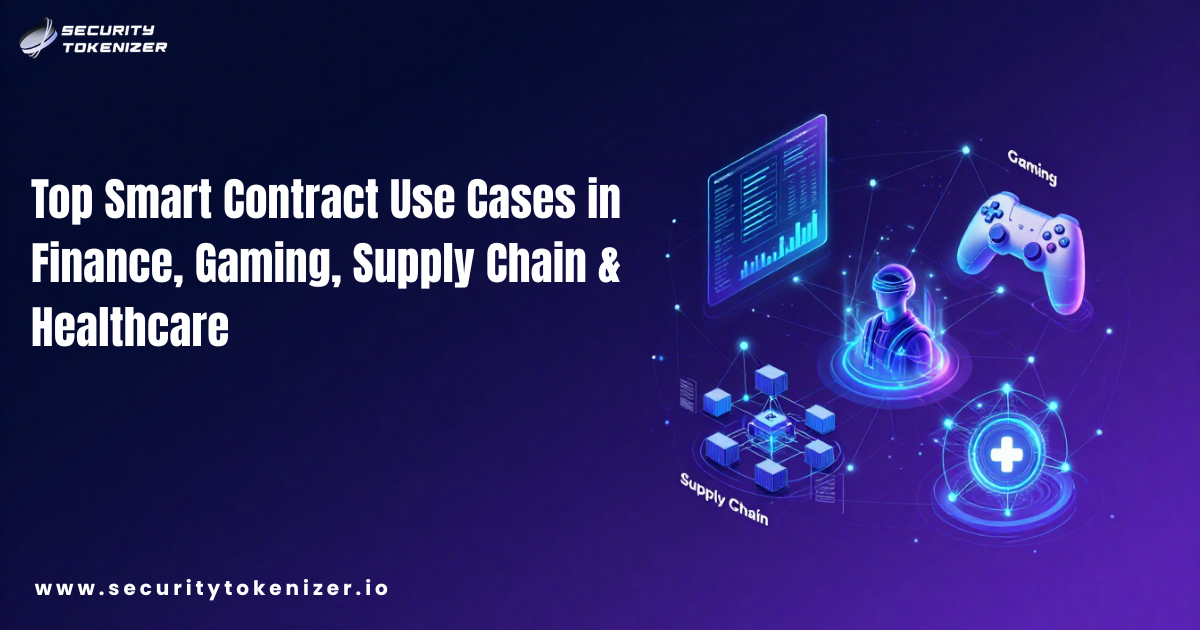
Table of Content
Smart contracts are self-executing programs on blockchain that automatically enforce agreement terms when conditions are met. Businesses adopt them to eliminate intermediaries, boost efficiency, and guarantee secure transactions across industries. They power DeFi protocols, supply chain tracking, and automated insurance payouts with unmatched transparency.
What Are Smart Contracts, and How Do They Work?
Smart contracts are self-executing digital agreements stored on a blockchain that automatically perform actions when predefined conditions are met. Developers typically write these contracts using programming languages like Solidity on networks such as Ethereum. Once deployed, the contract becomes immutable bytecode on the blockchain, meaning it cannot be altered and executes only when activated by transactions. This automation eliminates intermediaries while improving transparency, and the global adoption of smart contract use cases by 2026 has helped the market reach $3.12 billion in 2026.
Why Businesses Are Adopting Smart Contracts
Cost Reduction and Process Automation
Enterprises use smart contracts to automate agreements and workflows, reducing administrative expenses and disputes in financial and operational activities.
Reliable Finance and DeFi Operations
Smart contracts handle financial transactions securely, without needing banks or third-party middlemen. They operate in DeFi systems to support lending protocols.
Transparent and Efficient Supply Chains
Supply chains benefit from blockchain records that cannot be altered. This increases visibility and trust throughout global distribution networks.
Regulatory Clarity Driving Adoption
Government actions like India's required code audits and new U.S. blockchain laws are pushing companies to adopt these tools.
Rapid Enterprise Implementation
Over 60% of medium-sized and large organizations now use smart contracts in daily operations. This adoption is accelerating quickly.
Smart Contract Use Cases Across Various Industries
Finance and DeFi Platforms
Smart Contracts in Action: Finance Applications
Financial services have started using blockchain smart contracts in finance to automate lending, trading, and settlements. DeFi platforms such as Aave enable DeFi lending protocols to work automatically, which results in faster transactions without the need for trust.
Popular Firm: JPMorgan's Onyx platform trades around $2 billion of digital assets every day, relying on smart contracts that automate repos and settlements, thereby helping market businesses save approximately $20 million each year by eliminating middle-office processing.
Automated Insurance Systems
Smart Contracts in Action: Insurance Applications
Changes in digital technology have led insurance carriers to employ blockchain for automated insurance claim payouts. The claims are initiated immediately when the preset conditions have been met, which might be a flight delay or weather data, for example.
Popular Firm: AXA's Fizzy, a flight delay insurance based on smart contracts on Ethereum, was one of the first to automatically pay customers when flights were delayed through smart contracts, without any claims paperwork, and it helped in regaining customer confidence by providing smooth, immediate execution.
Product Transparency and Authenticity
Smart Contracts in Action: Supply Chain Applications
With the help of blockchain technology, supply chain transparency in tracking is brought to a higher level. It assists companies in confirming the origin of the product, its movement, and compliance with the trade laws through the entire international trade route.
Popular Firm: Walmart, in collaboration with IBM's Food Trust blockchain, uses smart contracts to track shipments from farm to store, decreasing time spent on tracing by 66% and facilitating quick reaction to contaminated food.
Gaming and NFT Ecosystems
Smart Contracts in Action: Gaming Applications
By incorporating gaming NFT smart contract applications, game developers are able to implement an automated system for in-game economies that allows game players to mint, trade, and manage digital assets securely.
Popular Firm: Highly popular platforms such as those that run Axie Infinity (which recorded more than $1 billion of peak revenues in 2021) are in the habit of using smart contracts for their in-game economies, which are fully automatic, thus making it possible to securely mint and trade assets that led to millions of daily transactions.
NFT Ownership and Digital Asset Control
Smart Contracts in Action: Digital assets use cases
The gaming industry has taken advantage of smart contracts in a significant way, as they allow gamers to not only own all their unique virtual items but also to transfer them across different marketplaces and platforms.
Popular Firm: OpenSea, the world's largest NFT marketplace processing billions of dollars, uses smart contracts for the transfer of ownership of NFTs over different platforms, which not only makes the transaction fees up to 90% lower than the fees charged by traditional brokers but also provides players with liquidity.
Healthcare Data Management
Smart Contracts in Action: Healthcare Instances
Healthcare providers have started to implement healthcare smart contract solutions that help them reduce administrative work. e.g., billing, record keeping, automation of healthcare workflows, and more secure ways to share medical data.
Popular Firm: Hitachi is a pioneer in using smart contracts in purchase processes with more than 3,500 suppliers. These contracts help operate in a more productive way by reducing the time needed for onboarding by almost 67% and by providing a saving of approximately 500 USD per supplier through automated verification and compliance.
Key Benefits of Smart Contracts Across Industries
Transparency and Trust in Transactions
Smart contracts store transactions on blockchain so everyone can see the details, and no one can change them after they're recorded. This eliminates the need for middlemen to verify deals.
Faster Execution and Automation
These digital agreements activate on their own, day and night. Payments, shipping schedules, and internal operations move faster without waiting.
Improved Security and Reduced Errors
Manual work is removed, so mistakes in payment systems drop by almost 90%. Data stays protected from unauthorized access.
Scalability Through Advanced Blockchain Infrastructure
Layer-2 upgrades improve how fast smart contracts process transactions. These systems support more users and more requests at once.
Growing Market Adoption Across Industries
Finance, supply chains, gaming platforms, and hospitals are adopting smart contracts faster than before. The global market should hit $3. 94 billion this year, growing 23.1% annually.
Future Trends of Smart Contract Applications
AI-Powered Smart Contract Intelligence
Incorporating AI brings predictive analytics and automated decision-making, which permit a contract execution that is smarter and more responsive.
Expansion of Cross-Chain Interoperability
Cross-chain bridges, which connect Ethereum and Solana networks, are facilitating users making data and asset transactions across different ecosystems with no interruptions.
Further Through Oracle-Based Automation
High-level oracle integrations are making it possible for protocol-level automation; thereby smart contract use cases are expanded to include IoT systems and tokenization of real estate.
Broadened Implementation in Emerging Industries
Besides the finance, healthcare, gaming, and logistics sectors, where smart contracts are used for greater efficiency and transparency, new industries are also adopting these contracts.
Robust Market Expansion and Long-Term Potential
Due to ongoing innovations and adoption at the enterprise level, the smart contract sector is projected to generate revenue of $7.73 billion by 2031, confirming its growth potential over the longer term.
Conclusion
Smart contracts are changing various sectors through automation, more transparency, and secure digital payments in finance, gaming, supply chain, and healthcare. As more and more people start to use them, companies should concentrate on selecting the most suitable technology and implementation plan. Working together with a dependable smart contract development company will give your business scalable and safe solutions that are perfectly aligned with your needs. Firms such as Security Tokenizer assist businesses in utilizing smart contracts in an efficient way, thereby enabling them to foster innovation, improve efficiency, and grow organically.